
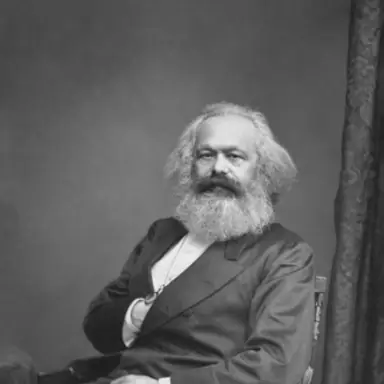
Portrait of Karl Marx

Karl Marx

Marxism · Modern · Germany

Wikipedia

Karl Marx was a German philosopher, social and political theorist, journalist, and revolutionary socialist. He developed the theory of historical materialism, analysing societal structure and change, particularly class struggle under capitalism, and predicting the system's ultimate replacement by communism. Marx co-authored The Communist Manifesto (1848) with Friedrich Engels, and undertook a critique of classical political economy in his magnum opus, Das Kapital (1867–1894). His ideas and their later development, collectively known as Marxism, have had enormous influence on intellectual, political, and social history, and have inspired revolutionary movements in many countries.

Summary from Wikipedia.

Saved takes

Does work give life meaning?

Marx saw free, creative labor as the core of human nature, the way people express and develop themselves. Under capitalism, however, work becomes alienated and strips people of control over their products and their own activity.

Work could be the fullest expression of human life, but when it is forced and owned by others it empties life of meaning instead of supplying it.

Source: Economic and Philosophic Manuscripts of 1844

Is equality more important than liberty?

Marx criticizes formal liberal liberty as hollow under capitalism, where economic class domination limits real freedom. He sees overcoming class inequality as the path to genuine human emancipation.

Legal rights to freedom mean little for workers who must sell their labor to survive; real liberty requires abolishing class relations.

Source: On the Jewish Question