
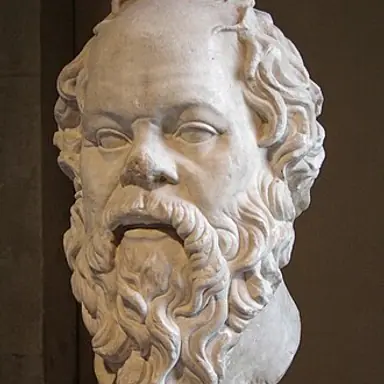
Portrait of Socrates

Socrates

Greek philosophy · Ancient · Greece

Wikipedia

Socrates was an ancient Greek philosopher from Classical Athens, perhaps the first Western moral philosopher, and a major inspiration on his student Plato, who largely founded the tradition of Western philosophy. An enigmatic figure, Socrates authored no texts and is known mainly through the posthumous accounts of classical writers, particularly his students Plato and Xenophon. These accounts are written as dialogues, in which Socrates and his interlocutors examine a subject in the style of question and answer; they gave rise to the Socratic dialogue literary genre.

Summary from Wikipedia.

Saved takes

Should I obey an unjust law?

In Plato's depiction, Socrates accepts a death sentence he thinks is unjust rather than escape. He argues that living under a city's laws creates an implicit agreement to obey them, and that persuasion, not evasion, is the proper way to resist.

A citizen who has benefited from the city and stayed under its laws has in effect promised to abide by them, even when a verdict goes against him; the right course is to try to persuade the city, not to slip away.

Source: Crito

What is wisdom?

Known through Plato's dialogues, Socrates treated wisdom as a kind of self-aware humility. He examined those reputed to be wise and found that real wisdom begins with recognizing the limits of one's own knowledge.

The wisest person is the one who knows how little they truly know, and who keeps questioning rather than assuming certainty.

Source: Apology (Plato)