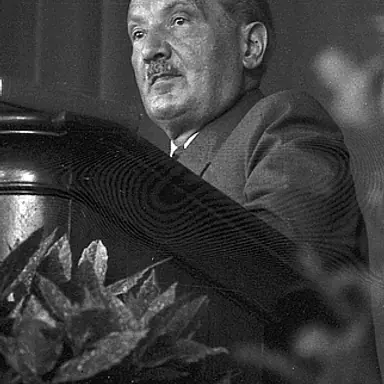
Heidegger focused on death as the defining horizon of human existence rather than on an afterlife. Facing one's mortality is what makes authentic living possible.
Death is my own most possibility; the question is less what lies beyond than how awareness of finitude shapes a genuine life.
Source: Being and Time
Heidegger ties time to the finite being of human existence. Temporality, structured by being toward death, is the horizon on which being itself is understood.
Human existence is fundamentally temporal, stretched between what has been and what it is projecting toward, and awareness of mortality gives time its meaning.
Source: Being and Time
Heidegger recovers the Greek notion of aletheia, truth as unconcealment. Propositional correctness depends on a prior disclosure of beings in the world.
Truth is first an event of things coming out of hiddenness, and statement-correctness is derivative of that opening.
Source: Being and Time
Heidegger called this the fundamental question of metaphysics and treated the encounter with nothingness, for instance in anxiety, as what discloses beings as such. For him the question is a way of becoming open to Being, not a request for a first cause.
Asking why there are beings at all pushes us to the edge of nothing, and in that experience the sheer fact of beings becomes startlingly visible.
Source: What Is Metaphysics?