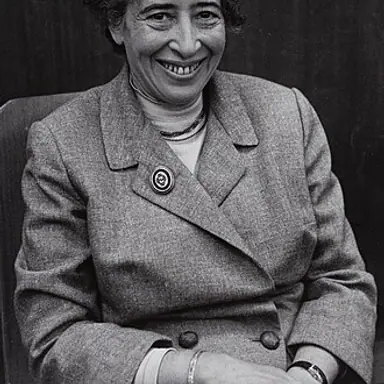
Arendt distinguished labor, work, and action. Labor sustains biological life, work builds a lasting world, and action in public with others is where distinctly human meaning appears. She worried modern society reduces everything to laboring.
Not all toil is equal: making durable things and especially acting and speaking among peers give life significance, while endless laboring for consumption does not.
Source: The Human Condition
Arendt sees promising as the human capacity that counters the unpredictability of the future, giving stability to shared life. Its binding force is political and relational, and forgiveness is its counterpart when promises fail.
Promises create islands of reliability in an uncertain world, so breaking them damages the shared world; yet forgiveness is needed because people inevitably fail.
Source: The Human Condition
Arendt studied political lying and its corrosion of the shared factual world. She saw deception as endemic to politics yet dangerous when it erases the distinction between fact and fiction.
Lies are an old political instrument, but organized deception destroys the common reality on which action and judgment depend, making it gravely harmful.
Source: Truth and Politics
Arendt sees forgiveness as the human capacity that releases us from the irreversible consequences of past action, allowing new beginnings. Without it we would be trapped by a single deed.
Forgiving is what keeps action from binding us forever to what has been done, though some offenses are too radical to be forgiven or punished.
Source: The Human Condition
Reflecting on Eichmann's trial, Arendt shows how appeals to duty and obedience can mask a failure to think. She argues that genuine responsibility requires independent judgment, not mere compliance.
Following orders and calling it duty can become a way of abandoning moral thought, so true duty demands personal judgment.
Source: Eichmann in Jerusalem
Observing the trial of Adolf Eichmann, Arendt concluded that great evil can be committed by ordinary people who fail to think. She called this the banality of evil, in contrast to her earlier idea of radical evil.
Terrible deeds need not come from monstrous motives; thoughtlessness and the refusal to judge for oneself can make a person an instrument of atrocity.
Source: Eichmann in Jerusalem
Arendt sees friendship as political in the broad sense, a form of dialogue through which people share the world and come to understand it. She links it to humanity in dark times, when personal trust sustains public life.
Friends keep a shared world alive through talk, and this ongoing conversation is itself what makes us more human, especially when public life fails.
Source: Men in Dark Times