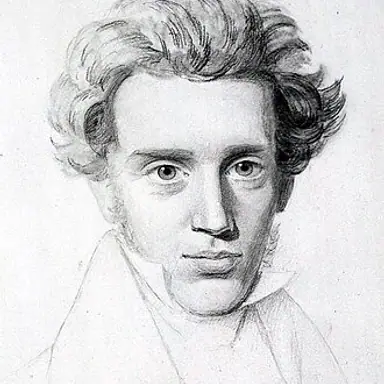
Kierkegaard argued that faith involves a passionate leap that exceeds and may offend objective reason. He saw attempts to rationally prove faith as undermining its nature as personal commitment.
Real faith lives in the tension with the absurd, and reducing it to rational proof drains it of inwardness.
Source: Fear and Trembling
Kierkegaard saw existence as full of paradox that reason cannot resolve. He proposed a leap of faith, embracing the absurd through commitment to God, as the way to live authentically.
Reason hits a wall in the face of existence, and the individual must make a passionate leap of faith that holds the absurd within it.
Source: Fear and Trembling
Kierkegaard insists that one must choose oneself and live with passionate inwardness rather than drift in social roles. Yet he also grapples with ethical duty and the demands of faith that can override the merely personal.
Truth must be lived with inward commitment, so the question is which task you can stake your whole self on, not what is merely expected or convenient.
Source: Either/Or
Kierkegaard distinguishes preferential love, such as erotic love and friendship, from neighbor-love grounded in duty. He argues that genuine love is a commitment that does not depend on the beloved's qualities.
Real love is a task and a commitment toward every person, not a feeling that rises and falls with preference.
Source: Works of Love
Kierkegaard describes the self as a relation that relates itself to itself, a synthesis of finite and infinite, necessity and possibility. Becoming a self is a task, and failing at it produces despair.
The self is not a given thing but an ongoing act of relating to oneself and, ultimately, to the power that established it.
Source: The Sickness Unto Death
Kierkegaard held that the central task is to find a truth for which one can live and die, and to commit to it passionately. Avoiding choice through conformity or abstraction is a form of despair.
Stop hiding in the crowd or in abstract theory and take up a personal commitment that you can wholeheartedly inhabit.
Source: Either/Or