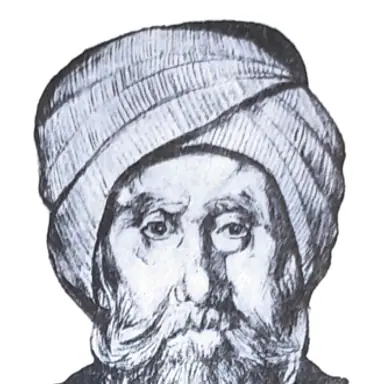
Al-Ghazali criticized philosophers for overreaching in metaphysics, arguing reason cannot settle matters of divine nature. He found certainty through direct mystical experience while still valuing logic in its proper domain.
Reason is useful in its sphere but cannot reach ultimate truths, which are tasted through spiritual experience.
Source: The Incoherence of the Philosophers
Al-Ghazali recounts a period of deep skepticism about both sense perception and reason. He says he was released from it not by argument but by a light of direct spiritual insight.
After doubting both senses and reason, I found reassurance not through proof but through an inner illumination that restored trust in knowledge.
Source: Deliverance from Error
Al-Ghazali defended God's existence and sovereignty against philosophers he thought overreached, while also arguing that direct spiritual experience gives certainty beyond rational argument.
Everything that begins has a cause, so the world points to a creator, and the surest knowledge of God comes through inner experience and purified practice rather than argument alone.
Source: The Incoherence of the Philosophers
Al-Ghazali described the soul (nafs, ruh, qalb) as a subtle, immaterial reality that knows God and is the real essence of a person. Its purification is the aim of spiritual life.
The human heart or spirit is a non-bodily reality whose true home is knowledge of God, and the body is its vehicle in this world.
Source: The Revival of the Religious Sciences (Ihya Ulum al-Din)
Al-Ghazali emphasized God's all-encompassing power while retaining human 'acquisition' of acts, so humans bear responsibility. He also questioned the necessity of natural causation, which affects how we think about determinism.
God creates all events, yet humans appropriate their acts in a way that grounds moral accountability; what looks like necessary causation is really God's habitual order.
Source: The Incoherence of the Philosophers
Al-Ghazali attacked the philosophers' claim that the world is eternal, arguing it must have begun through the free will of God. He saw an eternal past as incoherent with a world that depends on a willing creator.
The world was brought into being at a particular point by divine will, so its origin is a real beginning rather than an endless past.
Source: The Incoherence of the Philosophers
Al-Ghazali searches for certain knowledge, doubting the senses and reason before finding certainty through a divine light in the heart. Truth for him culminates in direct experiential knowledge of God.
After testing every source of knowledge and finding them fallible, he concluded that secure truth comes through an inner illumination granted by God.
Source: Deliverance from Error