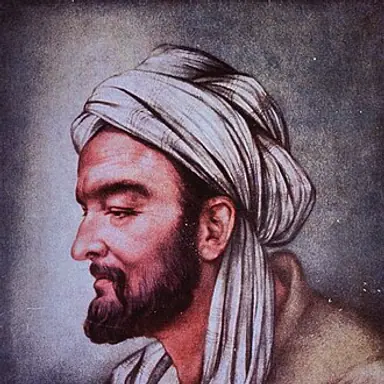
Avicenna described the universe as emanating necessarily from a necessary being. Existence flows from divine intellect, and each level of reality yearns toward its source.
The cosmos follows from the necessary existent through an ordered chain, and all things are drawn by desire toward the perfection of that source.
Source: The Book of Healing
Avicenna argued the soul is an immaterial substance distinct from the body. His thought experiment of the floating man suggests self-awareness does not depend on sensing the body.
Imagine a person created suspended in air with no sensation; they would still know they exist, which shows the self is not the body.
Source: Kitab al-Shifa (The Book of Healing)
Avicenna argued the rational soul is an immaterial substance that does not perish with the body. Its afterlife condition depends on the intellectual perfection it attained.
The intellect is not dependent on the body for its being, so it persists after death, happy or pained according to its knowledge and purification.
Source: Kitab al-Shifa (The Book of Healing)
Avicenna connects beauty with perfection and goodness of being. The more fully a thing realizes its nature, the more beautiful it is, with the Necessary Existent as supreme beauty.
Beauty is the fulfillment of a thing's proper perfection, and the highest beauty belongs to the first principle of all being, which is loved by all.
Source: The Metaphysics of The Healing
Avicenna used the thought experiment of a 'flying man' to argue for immediate self-awareness. He held that the self is known directly, prior to any awareness of the body.
Even someone floating without any sensory input would still be aware of their own existence, which suggests self-awareness is basic and not derived from the body.
Source: Kitab al-Shifa (The Book of Healing)
Avicenna develops Aristotle's account, linking time to the quantity of motion. He also explores the famous floating man thought experiment that bears on self-awareness apart from temporal sensation.
Time is the quantity of continuous motion in respect of earlier and later, and it depends on the celestial motion that grounds all change.
Source: The Book of Healing (Kitab al-Shifa)
Avicenna separated what is merely possible in itself from what is necessary through itself. Since contingent things cannot explain their own existence, a Necessary Existent must ground the whole chain.
Possible beings need an external cause to tip them into existence, and the series must terminate in a being that exists necessarily by its own nature.
Source: The Book of Healing