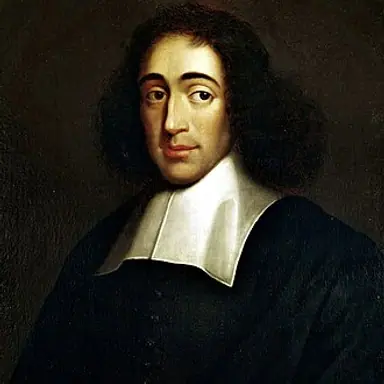
Spinoza denied free will as uncaused choice, seeing everything as following from the necessity of nature. He nonetheless described a kind of freedom as acting from understanding rather than from passive emotion.
People feel free only because they are ignorant of the causes shaping their desires; real freedom is acting from adequate understanding of necessity.
Source: Ethics
Spinoza rejected final causes in nature as a projection of human wishes. God or Nature acts from necessity, not for goals, so the universe has no purpose beyond its own necessary being.
People imagine that nature aims at ends because they themselves act for ends; in truth everything follows from the necessity of nature's own essence.
Source: Ethics
Spinoza rejected interaction between two substances, holding that mind and body are one reality understood under two attributes, thought and extension. They are not identical as descriptions, yet they are not separate things.
The order of ideas and the order of bodily events are the same underlying order seen in two ways, so mind and body neither cause nor exist apart from each other.
Source: Ethics
Spinoza identified God with the single infinite substance of nature itself, rejecting a personal, purposeful deity. His view is a rigorous pantheism grounded in necessity.
God is not a being apart from the world but the one infinite reality of which everything is an expression, acting by necessity rather than by will or purpose.
Source: Ethics
Spinoza held that everything follows necessarily from the nature of God or Nature, so free will in the sense of uncaused choice is an illusion. Real freedom is understanding the causes that move us and acting from reason rather than passion.
People believe themselves free only because they know their desires and not the causes behind them; genuine freedom is acting from adequate understanding.
Source: Ethics
Spinoza rejects free will as uncaused choice. Freedom means acting from the necessity of one's own nature, guided by adequate understanding rather than driven by passions.
We become free not by escaping causation but by understanding it, so our actions flow from our own reason rather than from external forces and emotions.
Source: Ethics
Spinoza defines love as joy accompanied by the idea of an external cause. He culminates in the intellectual love of God, which is the understanding of nature itself.
Love is the gladness we feel toward whatever we take to be the cause of our flourishing, and its highest form is the joy of understanding all things as part of nature.
Source: Ethics