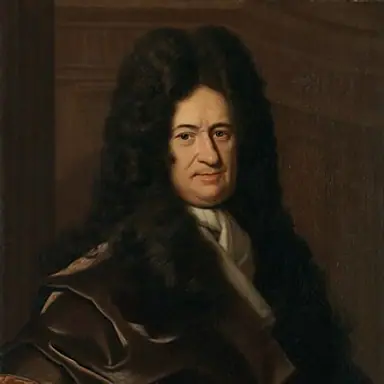
Leibniz argued that perception cannot be explained by mechanical parts and their interactions. Enlarging a thinking machine to the size of a mill and walking inside, he said, would reveal only moving parts, never an experience.
If you wandered inside a machine built to think, you would find only pieces pushing one another, nothing that could account for a perceiving subject.
Source: Monadology
Leibniz held that the universe is the product of a perfectly wise God who chose the best among possible worlds. Efficient causes and final causes work in harmony, so purpose pervades reality.
The actual world was selected for its overall perfection, and mechanical explanation and purposive explanation each describe the same ordered whole.
Source: Theodicy
Leibniz argued that perception cannot be explained by mechanical parts alone. Using the image of walking inside a brain-sized mill, he claimed one would find only gears pushing each other, never an experience.
No arrangement of moving physical parts, however intricate, would reveal a perception, so the mind cannot simply be a machine-like brain.
Source: Monadology
Leibniz coined the term theodicy and distinguished metaphysical, physical, and moral evil. He argued that evil is compatible with a perfect God because this world, with its evils, is the best of all possible worlds.
Evil comes from the inevitable limits of created things, and a wise creator permits it as part of the best overall arrangement of the whole.
Source: Theodicy
Leibniz rejects absolute time and argues it is a system of relations among events. Without events there would be nothing to distinguish one moment from another.
Time is simply the order of successive things; remove the things and their ordering, and no empty time remains.
Source: Correspondence with Samuel Clarke
Leibniz posed the question in its famous form and answered with the principle of sufficient reason. Because nothing is simpler than nothing, he argued the existence of anything demands a sufficient reason lying in a necessary being outside the contingent world.
Since nothing happens without a reason, the world's existence must be explained by a necessary being, and nothing would be easier and simpler than nothing.
Source: Principles of Nature and Grace
Leibniz coined the term theodicy for justifying God given evil. He argued that God chose the best possible world, in which some evils are necessary conditions of a greater overall good.
Among all possible worlds this one has the best balance of goods, and the suffering in it is part of what makes that whole best.
Source: Theodicy