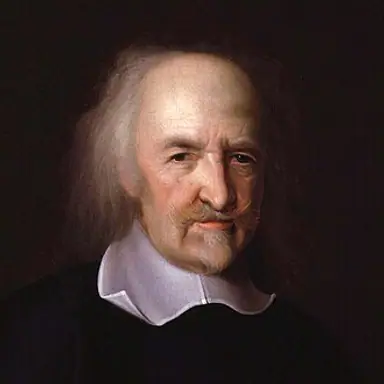
Hobbes defined liberty as the absence of external impediments to action. On this view, a fully caused action can still be free if the agent is not obstructed or coerced.
Being free means nothing stops you from doing what you want; that your wants have causes does not remove your liberty.
Source: Leviathan
Hobbes imagined a state of nature as a war of all against all and argued people rationally submit to an undivided sovereign for security. Divided authority, he thought, invites civil war.
Order and safety require a single, strong sovereign authority, because without one life becomes insecure and chaotic.
Source: Leviathan
Hobbes makes keeping covenants the third law of nature and the root of justice. But covenants made under no assurance that the other side will perform do not bind, since reasonable fear of non-performance releases one.
Promises must generally be kept because without that there is no peace, but where the other party is likely to cheat, one is not bound to perform first.
Source: Leviathan
Hobbes holds that the sovereign's commands define justice in civil society, and that the alternative to obedience is the chaos of the state of nature. Resistance is justified essentially only when the sovereign threatens one's life.
Because order depends on a single final authority, subjects should obey even harsh laws, since disobedience risks a return to war of all against all.
Source: Leviathan
Hobbes sees obligation as arising from covenants and the authority of the sovereign, who secures peace. Duty is tied to self-preservation and the rational pursuit of order over the war of all against all.
We owe obedience and fidelity because agreeing to them is the only reliable route out of insecurity.
Source: Leviathan
Hobbes defines freedom negatively as the absence of external impediments to motion or action. He holds that freedom is compatible with necessity and with fear, and that law does not remove liberty but shapes its scope.
A person is free when nothing external blocks what they are willing to do; liberty is simply unobstructed movement, even within a causal world.
Source: Leviathan
Hobbes sees justice as a product of covenant and sovereign authority. Without enforceable agreements there is no justice or injustice.
Justice amounts to keeping the agreements one has made, and it only has real meaning once a sovereign power exists to enforce them.
Source: Leviathan