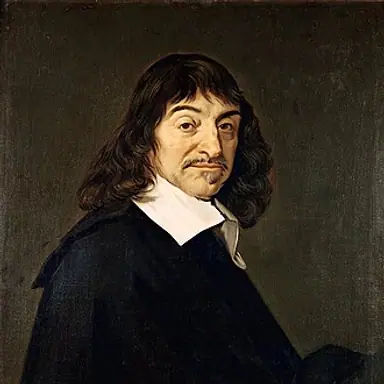
Descartes entertained the evil demon hypothesis, in which all sensory experience is a deception. He used this radical doubt to find a point of certainty in the thinking self.
Even if a powerful deceiver fabricated everything I perceive, the fact that I am thinking guarantees that I exist.
Source: Meditations on First Philosophy
Descartes used radical doubt to strip away every belief that could possibly be false. He found that the act of doubting itself reveals a thinking subject, giving a first indubitable foundation on which to rebuild knowledge.
Even if an evil deceiver tricks me about everything, I cannot be deceived about the fact that I exist while I am thinking; this is the bedrock of certainty.
Source: Meditations on First Philosophy
Descartes held that the mind is a thinking substance distinct from extended matter. He argued that machines, however cleverly built, could not use language flexibly or act with the general adaptability that reason shows.
A mechanism might imitate the outward behavior of animals, but it could never respond meaningfully to anything said in its presence or adapt to every circumstance the way a reasoning mind does.
Source: Discourse on the Method
Descartes treated animals as complex machines without thinking minds, which led many to deny they feel pain as we do. His view became a central target for later defenders of animal welfare.
Since animals lack a rational mind, their behavior can be explained mechanically, and they do not have the kind of inner life that would give them moral claims.
Source: Discourse on Method
Descartes began from doubt and found certainty first in the thinking self, then argued by way of God's non-deceiving nature that an external material world exists. He treated mind and matter as distinct substances.
My own existence as a thinker is the first certainty, but I can reason from it to the conclusion that a body-world distinct from my mind really exists.
Source: Meditations on First Philosophy
Descartes argued that mind is a thinking, non-extended substance distinct from the extended body, including the brain. He held that they interact, famously locating the interface in the pineal gland.
Because I can doubt that my body exists but not that I am thinking, the mind must be a different kind of thing from any physical organ.
Source: Meditations on First Philosophy
Descartes held that mind and body are two distinct substances, with the mind being a thinking, non-extended thing. This dualism raised the enduring problem of how they interact.
I can doubt the existence of my body but not that I am thinking, so the thinking self must be a different kind of thing from matter.
Source: Meditations on First Philosophy
Descartes made conscious thought the one indubitable certainty and distinguished thinking substance from extended matter. This framed the modern mind-body problem.
Mind is defined by thinking and is known with certainty from within, and it is fundamentally different in kind from physical stuff.
Source: Meditations on First Philosophy
Descartes grounds the self in the certainty of thinking: doubting everything, he still cannot doubt that he is a thinking thing. The self is an immaterial mind distinct from the body.
The one thing I cannot coherently doubt is that I am thinking, so the self is first of all a thinking substance.
Source: Meditations on First Philosophy