Platonism
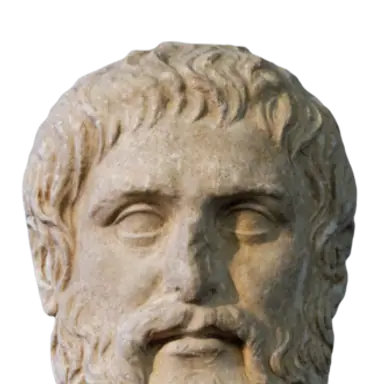
Plato held that the most real things are the eternal Forms, which exist independently of any human thinker. The sensible world is a dependent, imperfect copy, and knowledge consists in the mind coming to grasp what is already there.
What is truly real does not depend on our opinions; the mind discovers the Forms rather than making them, and the changing world we see only borrows its reality from them.
Source: Republic
Aristotelian realism
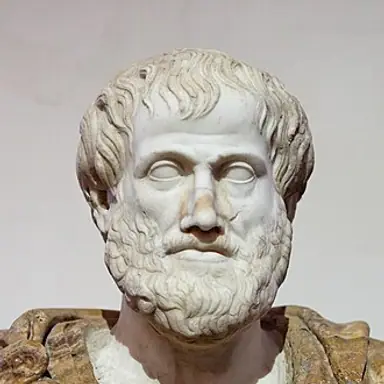
Aristotle argued that individual substances exist in their own right, with forms embedded in them. The mind comes to know them by abstracting those forms from experience, so knowledge conforms to things and not the other way around.
Things are what they are whether or not anyone thinks about them; the mind becomes knowing by taking on the form of the thing it understands.
Source: Metaphysics
Madhyamaka Buddhism
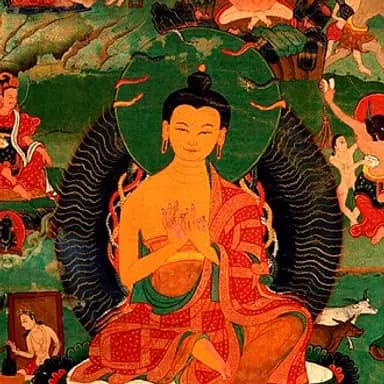
Nagarjuna argued that nothing has intrinsic, self-standing existence; all things arise dependently on causes, parts, and conceptual designation. This undermines both a strictly mind-independent reality and a purely mind-made one.
Nothing exists from its own side with a fixed essence; things are real only in dependence on conditions and on how we conceptually frame them, so the question's sharp split is itself misleading.
Source: Mulamadhyamakakarika
GB
1685–1753 · Ireland/Britain
Idealism
Berkeley argued that material substance is an incoherent notion and that to exist is to be perceived or to perceive. The world's stability is secured by God's constant perception.
Physical objects are collections of ideas, so they cannot exist apart from minds; the order of nature persists because an infinite mind sustains it.
Source: A Treatise Concerning the Principles of Human Knowledge
Rationalism
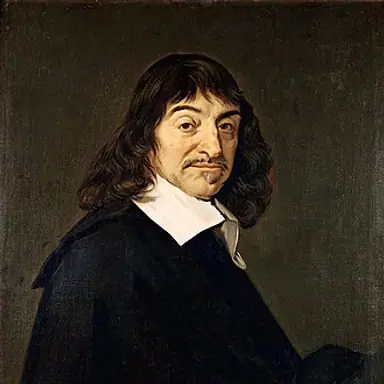
Descartes began from doubt and found certainty first in the thinking self, then argued by way of God's non-deceiving nature that an external material world exists. He treated mind and matter as distinct substances.
My own existence as a thinker is the first certainty, but I can reason from it to the conclusion that a body-world distinct from my mind really exists.
Source: Meditations on First Philosophy
Transcendental idealism
Kant distinguished appearances, which are shaped by the mind's forms of space, time, and categories, from things in themselves, which exist independently but are unknowable. Reality as we experience it is thus co-constituted by the mind.
Things exist independently of us, but all we can ever know is the world as structured by our own cognition, never things as they are in themselves.
Source: Critique of Pure Reason