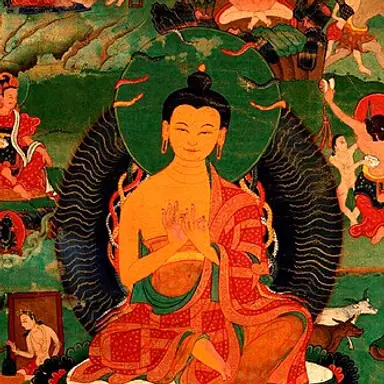
Nagarjuna used dialectical analysis to show that all concepts and claimed foundations lack inherent, independent existence. Seeking an ultimate certain ground is therefore misguided, though conventional knowledge still functions.
Every putative foundation turns out to depend on other things and to be empty of fixed essence, so certainty about ultimate grounds cannot be had.
Source: Mulamadhyamakakarika
Nagarjuna argued that all phenomena lack inherent, independent existence, a doctrine called emptiness. He saw this not as grounds for nihilism but as a middle way that dissolves clinging and frees one from suffering.
Things have no fixed essence, and seeing this clearly releases us from grasping without reducing life to nothingness.
Source: Mulamadhyamakakarika
Nagarjuna argued that nothing has intrinsic, self-standing existence; all things arise dependently on causes, parts, and conceptual designation. This undermines both a strictly mind-independent reality and a purely mind-made one.
Nothing exists from its own side with a fixed essence; things are real only in dependence on conditions and on how we conceptually frame them, so the question's sharp split is itself misleading.
Source: Mulamadhyamakakarika
Nagarjuna analyzed causation and inherent existence and concluded that things lack independent essence. His approach undermines the idea of a self-existing creator without relying on simple denial.
Nothing exists in an independent, self-grounded way, so positing an ultimate uncaused creator rests on a mistaken view of how things exist.
Source: Mulamadhyamakakarika
Nagarjuna criticized the idea of an ultimate first cause or independent origin, arguing that things exist only through dependence on other things. Questions about an absolute beginning rest on mistaken assumptions about inherent existence.
Nothing arises from an independent starting point, so seeking a first moment of all things misreads how conditions relate to each other.
Source: Mulamadhyamakakarika
Nagarjuna argued that all phenomena, including mind and experience, lack intrinsic essence and exist only dependently. This undermines the idea of a fixed self or a substantial consciousness.
Awareness has no independent, self-standing nature; it arises in dependence on conditions and is empty of any inherent core.
Source: Mulamadhyamakakarika
Nagarjuna analyzes time as a dependently arisen concept. Past, present and future cannot be established as independently real, since each presupposes the others.
If the present and future depend on the past, they would have to already exist in it; so time has no inherent, self-standing nature and is empty.
Source: Mulamadhyamakakarika
Nagarjuna distinguishes conventional truth from ultimate truth, arguing that all phenomena lack inherent existence. Ultimate truth is emptiness, itself not a thing to cling to.
Ordinary designations work conventionally, while the ultimate truth is that nothing has independent essence, and even this teaching is not a final doctrine.
Source: Mulamadhyamakakarika
Nagarjuna extended the Buddhist denial of a permanent self by arguing that all things, including persons, lack intrinsic nature and exist only dependently. Identity over time is a conventional designation.
No fixed self can be found either identical with or separate from the changing aggregates; sameness is a useful convention resting on dependent conditions.
Source: Mulamadhyamakakarika
Nagarjuna analyzed suffering as dependently arisen, not an inherent fixed thing. Seeing the emptiness of self and phenomena dissolves the grasping that sustains it.
Suffering depends on causes and conditions and lacks any fixed essence; understanding this emptiness loosens its grip.
Source: Mulamadhyamakakarika