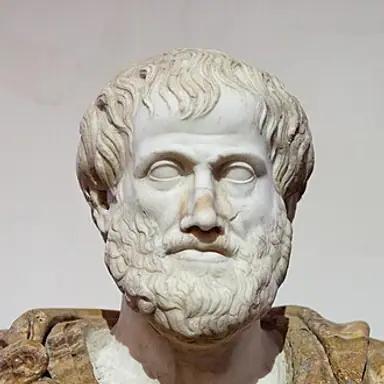
Aristotle argued for a single, finite, geocentric cosmos with Earth at its center. In his physics, the natural motion of earthy matter toward the center makes multiple worlds impossible. Life belongs to our world alone.
Since all earth naturally falls toward one center, there can be only one world, and so no other inhabited worlds elsewhere.
Source: On the Heavens
Aristotle placed living things on a hierarchy of soul, with animals possessing sensation and appetite but not rational thought. He held that animals exist in some sense for the sake of humans, though he studied them with great seriousness as natural beings with their own ends.
Animals have perceptive souls and their own natural functions, but because they lack reason they stand below humans in the order of nature and may be used for human purposes.
Source: History of Animals
Aristotle treats voluntary action as action whose origin lies in the agent who knows what they are doing. Moral responsibility follows from this, and character is built through habituated choices.
People are responsible for what they do knowingly and without compulsion, since the source of the action is within them; even our settled characters come from earlier choices we made.
Source: Nicomachean Ethics
Aristotle held that natural things are best explained by the ends they aim at, so purpose is built into nature. He did not picture a designer, but saw the cosmos as ordered toward actuality and ultimately drawn toward an unmoved mover.
Nature does nothing without an end; to understand why things are as they are, we must ask what they are for, and the whole cosmos is oriented toward the perfect activity of pure thought.
Source: Physics
Aristotle ties a good life to activity in accordance with virtue and reason, but he ranks contemplation above productive labor. Work needed for necessity is a means, while leisure is where the highest human ends are pursued.
Meaning comes from exercising our rational and moral capacities well; labor that only serves necessity falls short, and leisure spent in contemplation is the higher aim.
Source: Nicomachean Ethics
Aristotle compared actual constitutions and judged regimes by whether they serve the common good or only the rulers. He favored a mixed constitution anchored by a large middle class and rule of law.
The best practical regime balances the few and the many, is stabilized by a broad middle class, and rules for everyone's benefit rather than for a faction.
Source: Politics
Aristotle held that the virtuous person feels anger at the right things, toward the right people, to the right degree. Neither excessive meekness nor rage is admirable.
Respond to wrongdoers with measured anger, neither being a pushover who tolerates insult nor a hothead who overreacts.
Source: Nicomachean Ethics
Aristotle treats equality as proportional justice rather than strict sameness. Liberty matters as part of citizenship, but a good political order balances claims of freedom, wealth and merit.
Justice means treating equals equally and unequals in proportion to their relevant differences, so neither raw equality nor unlimited freedom is the highest aim.
Source: Politics
Aristotle rejected separate mathematical realms and argued that mathematical properties exist in physical things. The mathematician studies those features by abstracting them from other qualities.
Numbers and shapes are real features of material things, which the mind isolates by abstraction, so mathematics is neither a separate world nor a pure fabrication.
Source: Metaphysics
Aristotle grounded ethics in human nature and function, arguing that flourishing (eudaimonia) is an objective target achieved through virtuous activity. Yet he accepted that ethical precision is limited and depends on practical wisdom.
What is good for humans is fixed by what kind of beings we are, though applying that in particular situations requires judgment rather than exact rules.
Source: Nicomachean Ethics
Aristotle argued that individual substances exist in their own right, with forms embedded in them. The mind comes to know them by abstracting those forms from experience, so knowledge conforms to things and not the other way around.
Things are what they are whether or not anyone thinks about them; the mind becomes knowing by taking on the form of the thing it understands.
Source: Metaphysics
Aristotle treated the soul as the form of a living body rather than a separate substance. Mind-related capacities are the organized activities of a living organism, though he gave the intellect a special, puzzling status.
Mind is not a thing alongside the body but the way a living body is organized and active; separating them is like separating the shape of a wax seal from the wax.
Source: De Anima
Aristotle argued that an actually infinite body is impossible, so the cosmos must be finite in extent. He allowed only a potential infinity, such as endless divisibility or endless counting.
A real, completed infinite magnitude cannot exist; the world is a bounded sphere, and infinity only exists as a never-finished process.
Source: Physics
Aristotle treated the soul as the form of a living body, the organizing principle of its capacities for nutrition, perception, and thought. On this view the soul is not a separate substance, though he left the intellect as a puzzling exception.
A soul is what makes a body alive and functioning as it does; it is to the body as sight is to the eye, not a ghost inside a machine.
Source: De Anima
Aristotle ties moral responsibility to voluntary action, meaning action whose origin lies in the agent and which is done with knowledge of what one is doing. He treats deliberation and choice as real features of rational agents shaped by habit and character.
We are praised and blamed because our actions originate in us, and because our settled character, which we helped form, shapes what we choose.
Source: Nicomachean Ethics
Aristotle ties a good life to eudaimonia, flourishing through activity that expresses excellence. He sees fulfilment and contribution to the community as linked rather than opposed, since humans are political animals.
A flourishing life comes from exercising your distinctive excellences well, and because we live within a community, the best use of your talents also serves the shared good.
Source: Nicomachean Ethics
Aristotle treats anger as a fitting response to genuine injury, so long as it is felt toward the right person, to the right degree, and at the right time. The virtuous person is neither a pushover nor consumed by resentment.
Someone who never feels anger at being wronged is defective, not saintly; the aim is measured anger, and forgiveness fits when the wrongdoer's act was involuntary or the response has been proportionate.
Source: Nicomachean Ethics
Aristotle saw the household and family as a natural stage in human flourishing, a setting where friendship, virtue and shared life develop. Raising children is part of the larger life of a political animal, though it is not the only route to a good life.
A fulfilled life usually includes family bonds, because caring for offspring exercises virtues that solitary life cannot, but it must be pursued with practical wisdom about one's circumstances.
Source: Nicomachean Ethics
Aristotle held that the cosmos is eternal and uncreated, since motion and time can have no first moment. Any supposed beginning of change would itself presuppose a prior change.
Every beginning of motion would need an earlier motion, so the universe never had a true start and there is no absolute before to ask about.
Source: Physics
Aristotle sees humans as political animals whose flourishing depends on community. Obligations arise through virtues like justice, generosity, and friendship, which are practiced in proportion to what people deserve and need.
You owe others the excellences of character that make shared life good: fairness in dealings, generosity in giving, and loyalty in friendship.
Source: Nicomachean Ethics
Aristotle treated the soul as the form of a living body, so it is not a separate substance that simply travels on. He left open that the active intellect might be separable and eternal.
Soul and body are bound together like form and matter, so personal survival is doubtful, though pure intellect may be divine and lasting.
Source: De Anima
Aristotle links beauty to order, proportion, and definiteness, qualities found in well-made wholes. He grounds it in the observable structure of things rather than a separate realm.
A thing is beautiful when its parts are arranged in a fitting order and size, so that it forms a unified, graspable whole.
Source: Poetics
Aristotle treated the soul as the form of a living body rather than a separate substance. Awareness and perception are capacities of an organized natural body, not an independent thing.
Mind and perception are the activities of a living body's organization, so consciousness is what a suitably structured organism does, not a ghostly inner extra.
Source: De Anima
Aristotle links freedom to citizenship and self-rule in the polis. A free person is not living for another's purposes and takes part in ruling and being ruled in turn. Freedom is realized through rational activity and virtue.
To be free is to live for one's own ends rather than another's, sharing in the governance of the community and acting according to reason and virtue.
Source: Politics
Aristotle distinguishes three kinds of friendship: those based on utility, on pleasure, and on virtue. He treats the last as the highest form, since it involves wishing good for the friend for their own sake. Friendship is for him central to a flourishing life.
True friends love each other for who they are and for their good character, and such bonds endure because goodness endures; friendships of mere use or enjoyment dissolve when the benefit ends.
Source: Nicomachean Ethics
Aristotle distinguishes general justice, meaning lawfulness and virtue toward others, from particular justice, which concerns fair distribution and rectification. Justice involves proportional equality.
Justice means giving people what is proportionate to their merit or standing, and correcting wrongs in exchanges, so that equals are treated equally and unequals unequally.
Source: Nicomachean Ethics
Aristotle treats love mainly as philia, friendship, and distinguishes friendships of utility, pleasure, and virtue. The highest form involves mutual goodwill between people who value each other for their character.
The truest love is wishing good for another for their own sake, sustained over time by shared virtue and a shared life.
Source: Nicomachean Ethics
Aristotle links a successful life to eudaimonia, flourishing achieved through the active exercise of virtue and reason over a complete life. External goods help, but they are not the core.
A person succeeds when they live well over a whole lifetime by exercising their rational and moral capacities, not by collecting wealth or honors.
Source: Nicomachean Ethics
Aristotle argued that the best life is one of eudaimonia, or flourishing, achieved by exercising reason and the moral and intellectual virtues over a complete life. He saw humans as political animals who thrive in community with adequate friends and material resources.
A good life means developing your distinctive human capacities, especially reason and good character, and exercising them consistently, with friends and a community, across a whole lifetime.
Source: Nicomachean Ethics
Aristotle approaches the question through eudaimonia, the flourishing proper to a rational being. A good life is one in which human capacities, especially reason and virtue, are exercised well over a whole lifetime.
Life's purpose is to live well by actively developing and exercising excellence of character and intellect, within a community of friends and citizens.
Source: Nicomachean Ethics
Aristotle treats time as something tied to change and motion rather than an independent entity. It exists only insofar as motion can be counted, and he wonders whether time could exist without a soul to do the counting.
Time is the measure of change with respect to before and after; without something changing, and something to count the changes, there would be no time to speak of.
Source: Physics
Aristotle treats truth as a property of statements and thoughts that correspond to how things actually are. He grounds it in a realist view of being and discourse.
To say of what is that it is, and of what is not that it is not, is to speak truly; falsehood is the reverse.
Source: Metaphysics
Aristotle distinguished sophia, theoretical wisdom about the highest causes, from phronesis, practical wisdom in action. Both are intellectual virtues essential to a flourishing life.
Wisdom comes in two forms: contemplative grasp of the most fundamental truths, and the practical skill of judging well what to do in particular situations.
Source: Nicomachean Ethics
Aristotle held that the good life is eudaimonia, a flourishing that comes from exercising reason and the moral and intellectual virtues over a complete lifetime. External goods like friends, health and modest wealth support it but do not constitute it.
A good life is one spent actively using our distinctively human capacities well, in company with others and with enough circumstances to allow it, rather than merely feeling pleasure or collecting honors.
Source: Nicomachean Ethics
Aristotle treated the soul as the form of a living body, so a person's identity is tied to the continuing organization of a living organism. Sameness lies in the persistence of that form despite changing matter.
You persist as the same living being because the form that organizes your body and capacities continues even as its material is replaced.
Source: De Anima
Aristotle held that the best life is one of eudaimonia, flourishing, achieved by exercising reason and the virtues over a whole lifetime. Happiness is an activity, not a feeling, and depends on habit, friendship, and adequate circumstances.
Figure out what excellence is distinctive to a human being and practice it consistently, in good company, across a full life.
Source: Nicomachean Ethics
Aristotle traced the world's motion and change back to an unmoved mover, a pure actuality that sustains everything without itself changing. He did not ask why anything exists at all, but what explains the ongoing order of things.
The cosmos depends on a first, eternal actuality that moves other things as an object of desire, and this halts the regress of explanations.
Source: Metaphysics