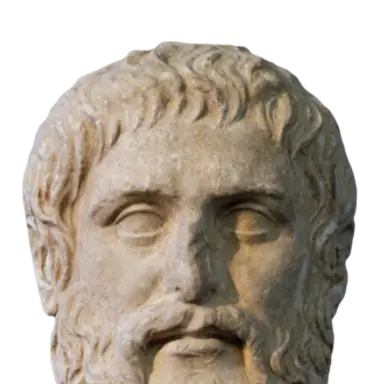
Plato's allegory of the cave imagines people who take shadows on a wall for reality. It is an ancient precursor to simulation worries, suggesting appearances may be a pale copy of a truer order.
Most people may be mistaking images for reality, and philosophy is the hard climb toward seeing what actually grounds those images.
Source: Republic
Plato treats understanding between persons as achieved through dialogue, where questions and answers gradually draw both toward shared truth. He is also wary of written words, which cannot answer back or adapt to the listener.
Real understanding happens in living conversation, when two minds test ideas together; fixed words alone cannot guarantee it.
Source: Phaedrus
Plato argued that a just society is ordered like a just soul, with reason governing appetite and spirit. He doubted that untrained majorities could rule well and proposed rule by philosophers educated to know the Good.
Political power should belong to those who have the knowledge and virtue to see what is truly good, not to whoever is popular or wealthy.
Source: Republic
In the Republic, Socrates examines the idea that justice means keeping one's word and returning what one owes. He tests it with a case where returning a weapon to a deranged friend would cause harm.
Keeping a commitment is not right in itself when doing so would bring serious harm; justice must be guided by understanding of what is truly good, not mechanical rule-following.
Source: Republic
Plato condemned the true lie in the soul but allowed rulers to use falsehood for the good of the city. His noble lie myth and talk of lying as medicine reveal a political exception.
Deceiving the soul about what is real is the worst falsehood, yet a guardian may use a useful fiction or medicinal untruth to secure civic harmony.
Source: Republic
Plato held that mathematical objects such as numbers and perfect geometrical forms exist in a realm independent of the physical world and of human minds. Mathematicians, on this view, come to know them through reason rather than create them.
Mathematical truths belong to an unchanging intelligible reality, and doing mathematics is a way of recollecting or grasping what already exists apart from us.
Source: Republic
Plato held that goodness is a real, mind-independent Form that can be grasped through reason and philosophical training. Moral knowledge is therefore a kind of insight into reality, not a matter of convention.
The Good exists independently of human opinion, and a just life is one aligned with that eternal reality, which the trained intellect can come to know.
Source: Republic
Plato held that the most real things are the eternal Forms, which exist independently of any human thinker. The sensible world is a dependent, imperfect copy, and knowledge consists in the mind coming to grasp what is already there.
What is truly real does not depend on our opinions; the mind discovers the Forms rather than making them, and the changing world we see only borrows its reality from them.
Source: Republic
Plato argued that the soul is an immortal, non-material entity that exists before and after the body. He divided it into rational, spirited, and appetitive parts, with reason meant to govern the rest.
The soul is the true self, akin to the eternal Forms, and it outlives the body that temporarily houses it.
Source: Phaedo
Plato argued that the soul is distinct from the body and akin to the eternal Forms. Death is the soul's release from the body, after which it is judged and may be reborn.
The soul is immortal and outlasts the body; death frees it to continue its journey, and its future depends on how justly it lived.
Source: Phaedo
Plato treats beauty as an objective reality that draws the soul upward. Earthly beautiful things awaken love, which can lead the lover from bodies to souls, to laws, and finally to beauty itself.
Beauty is a timeless Form; beautiful things merely share in it, and loving them rightly is a ladder toward the eternal.
Source: Symposium
Plato treats evil mainly as ignorance and disorder of the soul. Those who do wrong are failing to see what is truly good for them, so wrongdoing is a kind of sickness of understanding rather than a rival cosmic force.
No one knowingly pursues what is bad for them; wrongdoing comes from a soul that mistakes what is good, and evil is the harm that disorder does to the one who harbors it.
Source: Republic
Plato links justice to harmony in both the soul and the city. Each part performs its proper function without usurping others, guided by reason.
Justice is a kind of inner and civic order in which every part, whether of the soul or the state, does its own work under the rule of wisdom.
Source: Republic
In the Symposium, Plato presents love (eros) as a desire for beauty and the good that can be refined step by step. It begins with attraction to a single body and ascends toward contemplation of beauty itself.
Love is a longing for what we lack, and properly educated it leads the soul upward from particular beautiful things to the eternal form of Beauty.
Source: Symposium
Plato identifies the self with the rational soul, which is distinct from the body and akin to the eternal Forms. Self-knowledge means turning the soul toward truth and ordering its parts under reason.
The true person is the immortal, reasoning soul, which the body merely houses and often distracts from knowing what is real.
Source: Phaedo
Plato links truth to the intelligible Forms, which are stable and knowable through reason rather than the shifting world of appearances. Knowing truth requires turning the soul toward these realities.
Genuine truth belongs to unchanging Forms, and the philosopher's task is to move from shadows and opinion toward knowledge of them.
Source: Republic
Plato held that the true self is the immortal rational soul, distinct from the changing body. The soul's unchanging nature grounds a person's continuing identity.
What persists is the soul, which is akin to the unchanging Forms, while the body and its appearances shift constantly.
Source: Phaedo