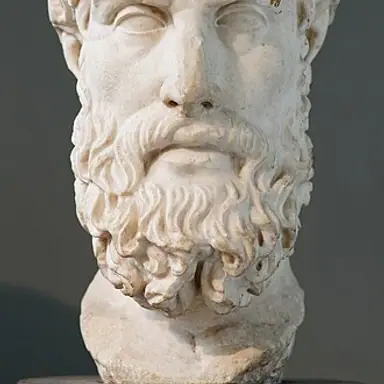
Epicurus held that the universe is infinite and made of atoms moving in void. From this he reasoned that the same natural processes that produced our world must have produced countless others. He saw no reason to think Earth unique.
In an endless cosmos of atoms, it would be strange if only one world had come to host living things; other worlds, with their own creatures, must exist.
Source: Letter to Herodotus
Epicurus accepted an atomist physics but resisted strict determinism, which he thought would undermine responsibility. His followers introduced a random atomic swerve to make room for agency.
If everything were fixed by necessity, praise and blame would make no sense, so nature must leave some room for events that are not wholly predetermined.
Source: Letter to Menoeceus
Epicurus held that the universe is made of atoms without cosmic purpose, yet a good life is attainable through simple pleasures, friendship and freedom from fear. Fear of death is irrational since death is nothing to us.
The lack of cosmic design is no reason for dread; tranquility, friendship and modest pleasures make life good, and death is no harm to the one who has died.
Source: Letter to Menoeceus
Epicurus rejected strict determinism and held that the motion of atoms is not wholly fixed in advance. This opening in nature, he thought, leaves room for human agency and responsibility.
If everything were fated, we could not be held accountable; nature must contain some indeterminacy so that our choices can be our own.
Source: Letter to Menoeceus
Epicurus prized tranquility and friendship, and reportedly counseled the wise to be wary of the anxieties that family life and public affairs can bring. Reports of his view are mixed, and the question turns on what secures lasting peace of mind.
Choose whatever path leaves you least disturbed and most able to enjoy simple pleasures and friends; children are a risk to that calm for some people and a source of joy for others.
Source: Letter to Menoeceus
Epicurus held that the soul is made of atoms that disperse at death. Since sensation ends, death cannot be experienced and so is nothing to fear.
When we exist death is absent, and when death arrives we no longer exist, so there is no experience of being dead to dread.
Source: Letter to Menoeceus
For Epicurus, friendship is among the most important sources of security and happiness in life. Though it may begin in mutual benefit, it grows into a valued good in itself, sustained within a community of like-minded people.
Of all the things wisdom provides for a blessed life, nothing surpasses the possession of friends, who give confidence and calm against life's uncertainties.
Source: Principal Doctrines
Epicurus held that the good life is pleasure properly understood: tranquility of mind and absence of bodily pain. This is achieved through simple living, friendship, and freeing oneself from irrational fears such as fear of death and the gods.
Seek calm, lasting contentment rather than extravagance: keep your desires modest, cherish friends, and dispel fears that needlessly disturb you.
Source: Letter to Menoeceus
Epicurus held that the aim of life is pleasure properly understood, meaning freedom from bodily pain and mental disturbance. Friendship, simple living, and freedom from fear of gods and death make this tranquility possible.
A meaningful life is a calm one, built on modest desires, good friends, and the recognition that death is nothing to us.
Source: Letter to Menoeceus
Epicurus argued that the good life is a pleasant one, understood chiefly as freedom from bodily pain and mental disturbance. Simple living, friendship and understanding nature dispel fear of the gods and death.
Happiness comes from modest desires satisfied, good friends, and a mind freed from groundless fears, not from luxury or ambition.
Source: Letter to Menoeceus
Epicurus argued that a good life aims at pleasure understood as tranquility and freedom from pain and fear. Simple living, friendship, and philosophical reflection achieve this better than ambition or luxury.
Live simply, cultivate close friendships, free yourself from needless fears, and do not chase wealth or status that cannot calm your mind.
Source: Letter to Menoeceus
Epicurus saw suffering as a natural part of embodied life, not a divine punishment. He sought to reduce it by limiting desires and removing groundless fears, especially of gods and death.
Much of our suffering comes from needless fears and excessive desires, and a simple life with friends can lessen it considerably.
Source: Letter to Menoeceus