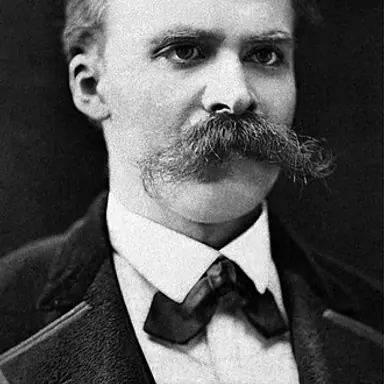
Nietzsche denied that the cosmos has any built-in aim, calling such beliefs shadows of the dead God. He urged people to create value and affirm life without a cosmic guarantee.
The world has no goal or intention waiting to be discovered, so meaning must be created by those strong enough to affirm existence as it is.
Source: The Gay Science
Nietzsche contrasted the noble person, who respects worthy enemies, with the resentful person consumed by ressentiment. A strong person does not nurse grudges.
Choose enemies worth having and honor them; a strong spirit shrugs off slights rather than poisoning itself with resentment.
Source: On the Genealogy of Morals
Nietzsche examined truth and lying as products of human drives and social convention. He saw that what we call truth is a mobile army of metaphors, which unsettles any simple moral line between lying and honesty.
Moral talk of truthfulness conceals power and need, so the question is less whether lying is wrong than what life-serving or life-denying purposes our truths and falsehoods serve.
Source: On Truth and Lies in a Nonmoral Sense
Nietzsche diagnosed nihilism after the death of God but refused despair. He urged the creation of one's own values and the affirmation of life, even through the thought of eternal recurrence.
The world has no built-in meaning, but that frees us to create values and to love our fate so fully that we would live it again.
Source: Thus Spoke Zarathustra
Nietzsche traced moral values to historical and psychological origins, denying that they have a timeless foundation. He saw moralities as expressions of types of life and power.
Moral systems are products of history and the needs of particular kinds of people, not discoveries of an objective moral order.
Source: On the Genealogy of Morality
Nietzsche diagnosed the decline of belief in God in modern Europe and explored its cultural and moral consequences. He saw the old foundations of values as collapsing and called for new creation of meaning.
Belief in God has lost its hold on modern people, and with it the foundation of our inherited morality, which leaves us to create values ourselves.
Source: The Gay Science
Nietzsche is suspicious of forgiveness when it springs from weakness and disguised ressentiment. He admires a strong person who simply lets slights pass, or who does not feel the need to forgive at all.
Forgiveness born of powerlessness is a moral pose; real strength shows in not being poisoned by grievance in the first place.
Source: On the Genealogy of Morality
Nietzsche historicizes moral categories, arguing that the concept of evil arose from the resentment of the weak toward the strong. He contrasts it with the older opposition of good and bad as noble versus base.
Calling something evil is often a reactive judgment born of resentment, and we should ask who invented the label and what interests it serves.
Source: On the Genealogy of Morality
Nietzsche values friendship as a relation between equals who challenge and spur one another on. He suggests that one should be able to be an enemy to one's friend and that friendship is a form of shared striving beyond comfort.
A real friend is a worthy opponent who spurs you to overcome yourself, not someone who merely soothes or flatters.
Source: Thus Spoke Zarathustra
Nietzsche criticized conventional morality as life-denying and urged individuals to create their own values and affirm life, including its suffering. He proposed embracing one's life so fully that one would choose to live it again.
Do not borrow your values from the herd; shape yourself into someone who can affirm life, hardships included, and become who you are.
Source: Thus Spoke Zarathustra
Nietzsche argued that with the decline of religious certainty, individuals must create their own values. He urged affirming life fully, even embracing its recurrence, rather than seeking meaning in another world.
Meaning is not given but made, by becoming who you are and saying yes to life with all its suffering.
Source: Thus Spoke Zarathustra
Nietzsche is suspicious of absolute truth, seeing it as bound up with power, language, and life-serving fictions. He advocates a perspectival approach to knowing.
What we call truth is a shifting set of metaphors and interpretations hardened by habit, and there is no view from nowhere, only many perspectives.
Source: On Truth and Lies in a Nonmoral Sense
Nietzsche criticized moralities that deny life and urged individuals to create their own values. Affirming existence, including suffering, and growing into who one is constitutes flourishing.
A good life is one you could embrace repeating eternally, built by shaping your own values and becoming what you are rather than conforming to herd morality.
Source: Thus Spoke Zarathustra
Nietzsche urged individuals to create their own values and become who they are, affirming life including its hardships. He challenged inherited moralities that deny life.
Shape your own values and affirm your existence so fully that you would be willing to live it again, struggles included.
Source: Thus Spoke Zarathustra
Nietzsche argued that humans can bear suffering if it has meaning, and that religions often supply meaning by condemning life. He urged affirming suffering as a condition of growth and strength.
What crushes us is not pain itself but pain without meaning; suffering can become a source of strength when we embrace it as part of life.
Source: On the Genealogy of Morals