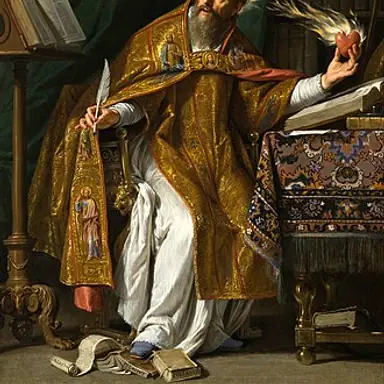
Augustine saw faith and understanding as mutually reinforcing: one believes in order to understand, and understanding deepens belief. Reason clarifies faith but begins within trust in authority and divine illumination.
Believe so that you may understand; faith opens the path that reason then walks further.
Source: Confessions
Augustine examines how signs and words convey meaning, concluding that words only prompt us, while understanding depends on an inner truth each person consults. Communication therefore points beyond itself to a shared source of insight.
Speech merely nudges the listener; real grasp occurs inside each mind, in light of a truth both can access.
Source: De Magistro
Augustine answered the Academic skeptics by pointing to truths that survive doubt, such as one's own existence and living. He also held that eternal truths are grasped through divine illumination.
If I doubt, I am; even someone who errs must exist to be mistaken, so at least this much is beyond skeptical attack.
Source: Against the Academics
Augustine argued that the will is free in choosing, and that evil comes from its misuse rather than from God. Later he emphasized that fallen human will needs divine grace to choose the good.
We genuinely will our own actions, and sin is our responsibility, yet after the Fall the will cannot turn toward goodness without grace.
Source: On Free Choice of the Will
Augustine argued that every lie is a sin because speech exists to convey what one thinks. He distinguished kinds of lies by gravity but refused to approve any as right.
Words are given so that minds can be disclosed to one another, so deliberately saying what you believe false misuses that gift, even for a good end.
Source: On Lying
Augustine defended the will as the source of sin against Manichaean fatalism, yet later stressed the need for divine grace to heal a will bound by sin. He wrestled with reconciling God's foreknowledge with human freedom.
The will is truly ours and is why evil is our responsibility, but a will damaged by sin cannot fully free itself without grace.
Source: On Free Choice of the Will
Augustine regarded marriage and procreation as genuine goods, though he ranked consecrated celibacy higher. He treated children as a gift and a responsibility within a life ordered toward God.
Having children is a real good when received as a gift and raised with love, yet it is not the highest calling, and a life can be wholly meaningful without it.
Source: On the Good of Marriage
Augustine argues that law divorced from justice is hardly law at all, and that states without justice resemble large bands of robbers. Still, he counsels Christians to endure earthly authority while owing final loyalty to God.
A rule lacking justice has little claim to be called law, yet believers should bear earthly power patiently, refusing only what God forbids.
Source: On Free Choice of the Will
Augustine argued that time is a feature of created reality, so asking what God did before creation misconstrues the nature of time. He treated time as bound up with change and with the creaturely mind's experience of duration.
There was no earlier moment before creation, because time itself began along with the world; God stands outside time rather than waiting within it.
Source: Confessions
Augustine taught that souls survive death and face judgment, with the righteous destined for eternal communion with God. The body will be resurrected at the end of time.
After death the soul awaits God's judgment, and in the end bodies rise so that the blessed enjoy eternal life with God and the damned are separated from him.
Source: The City of God
Augustine argued that war can be morally permissible when it punishes wrongdoing and restores peace, provided the inner motive is not cruelty or lust for domination. Authority and right intention matter as much as outward cause.
A war is just when waged under legitimate authority to correct a grave wrong and restore peace, while the fighters are free from hatred and love of violence.
Source: The City of God
Augustine, after rejecting Manichean dualism, argued that evil has no independent being. It is a privation or corruption of a good nature, arising when the will turns away from God toward lesser goods.
Evil is not a thing in itself but a lack of good, a distortion that enters when a free will loves lower things in place of the highest good.
Source: Confessions
Augustine distinguishes mere freedom of choice from true freedom. The will, damaged by sin, is only truly free when it is healed by grace and directed toward the good and God.
Merely being able to choose is a weak form of liberty; real freedom is the will's ability to love what is truly good, which requires divine grace.
Source: On Free Choice of the Will
Augustine writes movingly of the grief at losing a close friend and of the joys of shared life. He ultimately places friendship within the love of God, holding that human friends are truly loved when loved in God.
Friendship is sweet and deep, but it is secure only when grounded in a shared love of God, otherwise loss will shatter the soul.
Source: Confessions
Augustine sees love as the fundamental motion of the human will, which shapes who we are. Rightly ordered love directs itself to God first and to other things in God.
We are what we love; the heart is restless until its loves are rightly ordered and it rests in God.
Source: Confessions
Augustine argued that human beings are made for God and that the heart is restless until it finds its end in him. Meaning is found in rightly ordered love directed toward the highest good.
Life's meaning is union with God; all lesser loves are fulfilled only when ordered toward that ultimate source.
Source: Confessions
Augustine turns inward, finding the self in memory, understanding and will, and as a restless mystery to itself. The self is made in God's image and finds rest only in God.
I am a puzzle to myself, a deep inner space of memory and desire that is only fulfilled when oriented toward God.
Source: Confessions
Augustine confesses that he knows what time is until asked to explain it. He locates past, present and future in the mind as memory, attention and expectation, and sees God as outside time.
The past exists only as present memory, the future as present expectation, so time is a kind of stretching of the soul.
Source: Confessions
Augustine argued that God created a good world and that evil is not a substance but a privation of good. Suffering follows from the misuse of free will and the fall of humanity.
Evil is a lack of good rather than a thing in itself, and suffering enters the world through the turning of free creatures away from God.
Source: Confessions