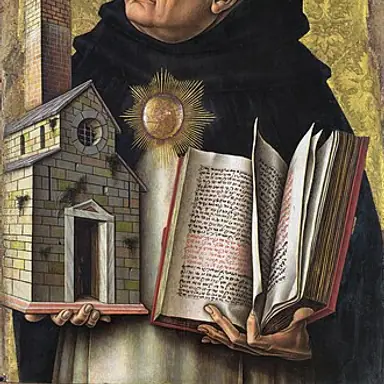
Aquinas held that truth is one, so revealed truths and truths found by natural reason cannot ultimately conflict. Reason can establish preambles of faith, such as God's existence, while faith completes what reason cannot reach.
Grace does not destroy nature but perfects it; since God authors both revelation and the human mind, properly used reason and faith must harmonize.
Source: Summa Theologiae
Aquinas held that rational nature alone grounds direct moral claims, and that animals are ordered to human use under divine providence. He nonetheless warned that cruelty to animals can habituate people to cruelty toward humans.
Animals are not owed duties of justice for their own sake, yet cruelty toward them is wrong because it corrupts character and disorders our treatment of fellow humans.
Source: Summa Contra Gentiles
Aquinas held that humans act through reason and will, choosing among goods presented by the intellect. He saw divine providence and human freedom as compatible because God works through secondary causes.
Because we can deliberate about different goods, our choices are our own, and God's governance operates through rather than against our freedom.
Source: Summa Theologiae
Aquinas argued that the regularity of natural things acting toward ends points to an intelligent source directing them. The universe's purpose is grounded in God as its first cause and final good.
Things lacking intelligence still act for ends, so they must be directed by a mind; creation as a whole is ordered toward the divine goodness.
Source: Summa Theologiae
Aquinas holds that fidelity to promises is a part of justice, yet obligations depend on the promise being for a possible and morally good end. Changed circumstances can excuse a person from performing what was promised.
One should keep promises ordinarily, but if conditions shift so that fulfilment would be wrong or truly harmful, not performing it does not count as vice.
Source: Summa Theologiae
Aquinas classed lies as officious, jocose, or malicious and held all to be sinful in kind, though differing in severity. He allowed concealing the truth or speaking evasively when justice or charity requires.
Asserting a falsehood is always wrong, yet one need not reveal everything; prudent silence or discretion can protect others without lying.
Source: Summa Theologiae
Aquinas taught that moral truths are grounded in natural law, humanity's rational participation in God's eternal order. Basic precepts are accessible to reason and universal.
Right and wrong are fixed by an order built into creation, and any reasoning person can discern its basic demands.
Source: Summa Theologiae
Aquinas argued that God's existence can be demonstrated by reason from features of the world such as motion, causation, contingency, and order. He treated God as the necessary, uncaused source of all being.
Because things in the world move, depend on causes, and might not have existed, there must be a first, necessary reality on which everything else rests, and that is what people mean by God.
Source: Summa Theologiae
Aquinas combined Aristotle with Christian doctrine: the soul is the form of the body but the rational soul is subsistent and immortal. It is created by God and survives death, awaiting reunion with the body.
The human soul is both the body's animating form and an intellectual principle that can exist apart from matter after death.
Source: Summa Theologiae
Aquinas argued that rational beings choose by means of intellect and will, so they are free even though God is the first cause of all things. Freedom consists in rational self-direction toward the good rather than in absence of causes.
Because we act by reasoned judgment about what is good, our choices are our own, and divine causation works through rather than against that freedom.
Source: Summa Theologiae
Aquinas holds that humans are ordered toward the good and ultimately toward God, and that vocations differ in gifts and roles. Work is good when it serves the common good and fits one's nature.
Our inclinations point toward real goods, and different people are suited to different tasks; the best path joins your natural gifts with service of the common good.
Source: Summa Theologica
Aquinas holds that a human law contrary to natural law lacks the true force of law and is more a corruption of law than law. He allows that one may sometimes comply to avoid scandal or disorder, but never when the law commands something against God.
An unjust human rule does not bind in conscience as law should, though prudence may counsel compliance to prevent greater harm, unless it demands a wrongful act.
Source: Summa Theologiae
Aquinas developed natural law ethics and the doctrine of double effect, holding that an act's goodness depends on its object, intention, and circumstances. A good end never makes an intrinsically evil act permissible.
An evil act stays evil whatever good one hopes it will bring, though foreseen side effects of a good act may be tolerated under careful conditions.
Source: Summa Theologiae
Aquinas treats justice as giving each person their due, grounded in natural law and the common good. Charity adds a further duty of love for neighbour that goes beyond strict debt.
You owe others what is rightfully theirs in justice, and beyond that a love that wills their good as part of the common good.
Source: Summa Theologiae
Aquinas systematized earlier thinking into three conditions for just war, forming the backbone of later just war theory. He grounded them in natural law and the common good.
War is permissible if declared by a legitimate sovereign, fought for a just cause such as answering serious wrong, and driven by a right intention aimed at good rather than vengeance.
Source: Summa Theologiae
Aquinas ties beauty to the pleasure of knowing. He identifies integrity, proportion, and clarity as its marks, rooted ultimately in God.
The beautiful is what pleases when it is seen or understood, owing to wholeness, right proportion, and brightness.
Source: Summa Theologiae
Aquinas develops the privation view systematically, defining evil as the absence of a good that a thing ought to have. He distinguishes natural evils from moral evil, which stems from willed disorder in human action.
Evil is the missing of a due perfection in something; moral evil occurs when a person chooses an apparent good in a way that violates right reason.
Source: Summa Theologiae
Aquinas builds on Aristotle, defining friendship as mutual benevolence grounded in some shared good. He extends the idea by describing charity as a friendship between humans and God.
Friendship is mutual well-willing between persons who share in a common good, and the highest form is the friendship of humans with God, which also shapes love among people.
Source: Summa Theologiae
Aquinas defines justice as a virtue directed at others and grounded in natural law. Unjust human laws lose their binding moral force.
Justice is the steady and lasting will to render to each person what is due to them, measured by a natural law that reflects divine reason.
Source: Summa Theologiae
Aquinas defines love as willing the good of another and analyzes it as the root of all other passions. He integrates Aristotelian friendship with Christian charity.
To love is to will good to someone, and charity is a friendship between humans and God that shapes all other loves.
Source: Summa Theologiae
Aquinas synthesized Aristotle with Christian theology, arguing that humans find imperfect happiness through virtue in this life but ultimate fulfillment only in the vision of God. The good life orders the cardinal and theological virtues toward that end.
Cultivate prudence, justice, courage, and temperance, and let faith, hope, and love direct your life toward union with God, which alone fully satisfies.
Source: Summa Theologiae
Aquinas develops the correspondence theory, defining truth as the conformity of intellect and thing. He also roots truth in God's mind as the ultimate measure of things.
Truth is found when the mind matches reality, and all created things are true insofar as they conform to the divine intellect that conceived them.
Source: Quaestiones disputatae de veritate
Aquinas ranked wisdom as the highest intellectual virtue, ordering all knowledge toward the ultimate cause, God. He also treated it as a gift of the Holy Spirit that perfects reason through divine love.
The wise person sees how all things are ordered to their final end and judges everything in light of that highest truth.
Source: Summa Theologiae
Aquinas fused Aristotelian ethics with Christian theology. Natural virtues bring partial happiness in this life, but complete fulfillment lies in the vision of God, aided by faith, hope and charity.
Human beings are made for a happiness that finite goods cannot fully satisfy, so a good life orders virtue and love toward union with God.
Source: Summa Theologiae
Aquinas distinguished beings whose essence does not include existence from a being whose essence is existence itself. He held that contingent things need a cause that gives them being at every moment, which he identified with God.
Everything that merely happens to exist must be sustained by something whose nature is to exist, and that is what we call God.
Source: Summa Theologiae